

Make Your Website Lead-Ready with AI SEO
May 18, 2026
Marketing Automation for Shopify Stores: Build a Predictable Revenue Engine on Autopilot
June 8, 2026Marketing Automation for Info Product Businesses: How to Build a Predictable Sales Engine
You’ve spent months perfecting your course. You’ve filmed the modules, designed the workbooks, and you know your coaching can change lives. But instead of changing lives, you’re spending your afternoons manually replying to “How much?” comments on Instagram or hunting through your inbox to find a lead that went cold three days ago.
If you feel like you’re running on a treadmill—working harder but staying in the same place—you’re not alone. Most info product creators, coaches, and consultants hit a ceiling where their manual effort simply can’t keep up with their growth. This is where the chaos begins, and unfortunately, where most businesses stall.
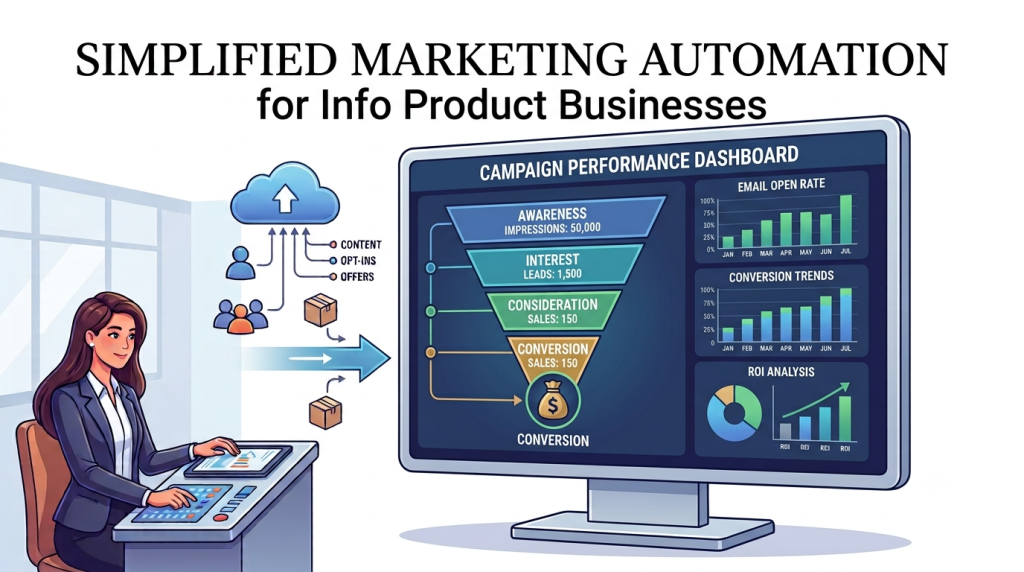
The good news? There is a way to step off the treadmill. By building a predictable sales engine using marketing automation for info product businesses, you can turn that chaos into a streamlined, scalable system that works 24/7—even while you sleep.
What is Marketing Automation for Info Product Businesses?
Marketing automation for info product businesses refers to using software, workflows, and CRM systems to automatically capture, nurture, and convert leads into paying customers for digital products like courses, coaching programs, and consulting services.
Simple Definition
Marketing automation is the process of using tools and workflows to:
- Capture leads automatically
- Nurture them with emails, WhatsApp, or SMS
- Segment users based on behavior
- Convert prospects into customers without manual follow-ups
In simple terms, it acts as your digital sales assistant that works 24/7.
What is Marketing Automation, Anyway?
Marketing automation simplifies your entire sales funnel by removing repetitive manual work and replacing it with intelligent workflows.
With the right marketing automation system for course creators, you can:
- Respond instantly to new leads
- Send personalized follow-ups automatically
- Segment your audience based on behavior and interest
- Move prospects through your funnel without manual intervention
Quick Example of a Marketing Automation Workflow
Imagine someone downloads your free guide at 2:00 AM:
- They instantly receive the resource
- Their data is captured in your CRM
- They are tagged based on interest (e.g., Beginner, Advanced)
- They enter an automated email nurturing sequence
- They receive a WhatsApp follow-up within 24 hours
This is how a sales funnel automation system for course creators works silently in the background.
👉 Businesses using automated follow-ups often see 2–3x higher conversion rates, while WhatsApp marketing automation can achieve 80–90% open rates, making it one of the most powerful engagement channels today.
Why Info Product Businesses Struggle Without Marketing Automation
Most coaches and course creators are experts in their domain—but scaling requires systems, not just skills. Without automation for coaching businesses, inefficiencies quickly compound.
The “Leaking Bucket” Problem
You invest time and money into generating leads—but without proper CRM automation for online businesses, those leads are not managed effectively.
Common issues include:
- Leads not tracked or centralised
- Missed or delayed follow-ups
- High-intent prospects going cold
Over time, this creates a revenue leak that limits your growth.
The Manual Follow-Up Trap
Research shows most conversions happen between the 5th and 12th touchpoints. But manually managing that many interactions is unrealistic.
Without lead nurturing automation, you:
- Stop after 1–2 follow-ups
- Lose high-intent prospects
- Miss out on compounding conversions
A well-designed marketing automation system for info product businesses removes this dependency and creates a scalable, process-driven growth engine.
Burnout and “Founder Fatigue”
When you are handling sales, marketing, and support manually, your business becomes dependent on your time and energy.
- If you stop → revenue stops
- Growth becomes inconsistent
- Burnout becomes inevitable
A well-built marketing automation system transforms your business into a scalable, process-driven machine.
What a Complete Marketing Automation System Looks Like
A high-performing system is not just email automation—it’s a connected sales ecosystem designed to move leads from discovery to conversion.
Here’s how a complete CRM and sales automation system works:
1. The Brain: CRM and Lead Management
Everything starts with a centralised CRM for course creators. Instead of scattered data, every lead is tracked, tagged, and segmented.
For example:
- Someone interested in SEO → tagged accordingly
- Someone exploring beginner content → segmented differently
This allows hyper-personalised communication, significantly improving engagement and conversions.
2. The Conversation: Social Media and WhatsApp Automation
Today’s audience interacts through DMs, not just emails. Social media automation allows instant engagement when someone comments or messages you.
Even more powerful is WhatsApp marketing automation for businesses, which enables:
- Instant communication
- Higher open rates
- Faster decision-making
This creates a seamless communication experience that feels personal, not automated.
3. The Filter: Lead Grading and Qualification
Not every lead is ready to buy—and that’s okay. The goal is to identify who is.
With lead scoring and qualification systems:
- Engagement increases lead score
- Buying intent signals are tracked
- High-quality leads are prioritised
You can also automate pre-qualification using simple workflows:
- Forms
- Chat responses
- Pre-call questionnaires
This ensures your time is spent only on high-intent prospects.
4. The Closer: Proposal and Invoicing Automation
Once a lead decides to move forward, speed becomes critical. Delays often lead to drop-offs.
With sales automation workflows:
- Proposals are sent instantly
- Payment links are included
- Follow-up reminders are triggered
This reduces friction and improves conversion rates significantly.
A Day in the Life of an Automated Sales Engine
Let’s look at how this feels in reality for a prospective student named Sarah:
- Let’s see how this works in reality:
- 9:00 AM: Sarah comments “GROWTH” on your Instagram Reel
9:01 AM: She receives an automated DM with a lead magnet
9:05 AM: She signs up → CRM tags her as “Masterclass Lead”
Next 3 Days: She receives value-driven emails (automated nurturing sequence)
Day 4: She books a call via your automated calendar
Post-Call: Proposal + invoice sent instantly
Payment: She enrolls and receives onboarding details automatically
You only step in at the decision-making stage, where your involvement matters most.
Why Most Businesses Fail at Automation
If automation is so powerful, why do most businesses struggle with it?
The most common reasons include:
- Tools Without Strategy
Investing in platforms without a clear funnel leads to confusion and wasted resources. - Overcomplication
Complex workflows often break and become difficult to manage over time. - Lack of Human Touch
Automation that feels robotic reduces trust and engagement.
The key is to build a system that balances automation + human touch.
How Paarami Digital Builds Your Engine
At Paarami Digital, the focus isn’t just on tools, it’s on building a complete, scalable system tailored to your business.
We design and implement:
- CRM and lead segmentation systems
- Email and WhatsApp automation workflows
- Lead nurturing sequences
- Funnel optimization strategies
The goal is simple:
👉 Remove the operational chaos and build a predictable, scalable sales engine.
Conclusion: From Chaos to Clarity
A marketing automation system for your course or coaching business isn’t just a luxury anymore; it’s a necessity for survival in a crowded market. It’s the difference between a business that feels like a constant fire drill and one that feels like a well-oiled machine.
Imagine waking up to see that three new students joined your program overnight, two discovery calls were booked for Thursday, and your follow-ups were handled—all while you were offline.
Ready to stop the manual grind?
Let’s build your predictable sales engine together.
Book a free automation audit with Paarami Digital today, and let’s find the leaks in your bucket.
FAQ
1. What tools are used for marketing automation?
Common tools include CRM platforms, email marketing software, WhatsApp automation tools, and funnel builders like HubSpot, ActiveCampaign, and Zapier.
2. Is marketing automation expensive?
It depends on your setup, but most businesses see a high ROI due to increased conversions and time savings.
3. How long does it take to implement marketing automation?
A basic system can be set up in 2–4 weeks, while advanced funnels may take longer, depending on complexity.
4. Can small coaching businesses use marketing automation?
Yes. In fact, automation is most impactful for small teams as it reduces manual workload and improves efficiency.
5. Does automation reduce personalisation?
No, when done correctly, it actually improves personalisation through segmentation and behaviour-based messaging.