Marketing Automation for Info Product Businesses: How to Build a Predictable Sales Engine
June 1, 2026
Marketing Automation for Dentists: How to Build a Predictable Patient Acquisition System.
June 15, 2026Marketing Automation for Shopify Stores: Build a Predictable Revenue Engine on Autopilot
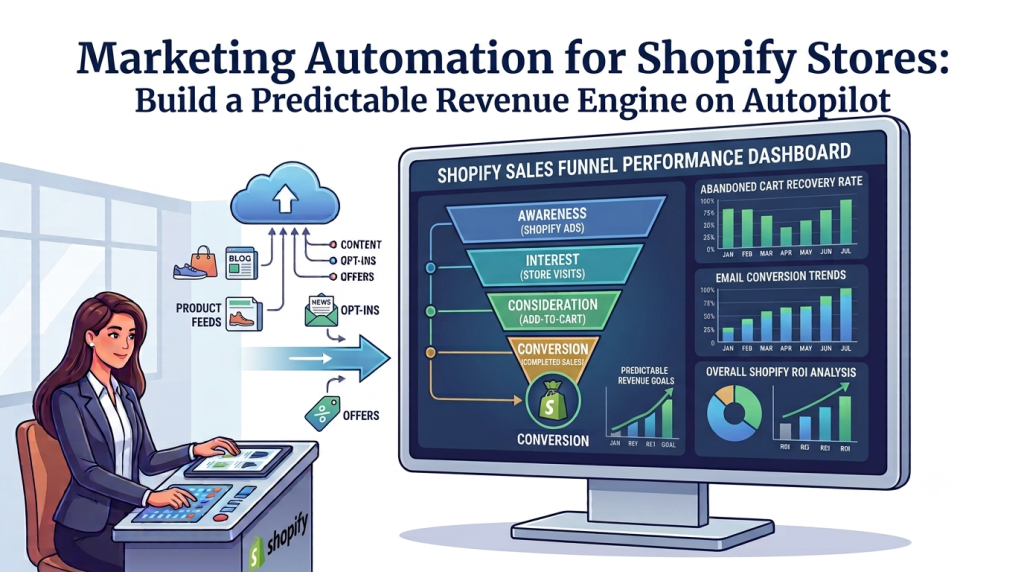
Your marketing strategy shouldn’t feel like a second full-time job. If you are running a Shopify store, you already know the drill: managing inventory, handling shipping, and trying to keep customers happy. But as you scale, the manual “hustle” of manually emailing leads or chasing abandoned carts becomes a bottleneck.
This is where automation steps in. It’s not about losing the human touch; it’s about using technology to ensure no lead is ignored, and no customer is forgotten.
Below is a comprehensive guide on Marketing Automation for Shopify stores, designed to help you build a self-sustaining sales engine.
What is Marketing Automation for Shopify stores?
Marketing automation for Shopify stores is a system that uses CRM tools, email workflows, WhatsApp automation, and customer segmentation to automatically capture leads, nurture prospects, and drive repeat purchases without manual effort.
Quick Summary:
- Automates lead capture and follow-ups
- Personalises customer communication
- Recovers abandoned carts and lost leads
- Increases conversions and repeat purchases
What You’ll Learn
- How Shopify automation improves conversions and retention
- The role of CRM, WhatsApp, and email automation
- How to segment, nurture, and re-engage customers
- A step-by-step breakdown of high-converting automation systems
Why Shopify Stores Need Marketing Automation
Running a Shopify store without automation is like running ads without tracking your spending time and money, but you don’t know what’s actually working.
Without automation:
- Leads inquire but don’t get timely responses
- Customers purchase once and disappear
- No structured follow-up or upsell strategy
- Manual work consumes valuable time
With Shopify marketing automation:
- Capture every lead automatically
- Nurture customers based on behaviour
- Automate follow-ups, upsells, and reminders
- Increase customer lifetime value (LTV)
- Build predictable, scalable revenue
Industry insight: Automated emails alone can drive 25–30% of total eCommerce revenue.
The Engine Under the Hood: Why Automation is Non-Negotiable
In today’s competitive eCommerce landscape, speed to lead is everything. A customer’s interest fades quickly if not engaged instantly.
Automation ensures:
- Immediate responses to inquiries
- Continuous engagement through workflows
- Personalised communication at scale
Whether it’s a WhatsApp message, abandoned cart reminder, or email sequence automation keeps your brand active 24/7.
1. CRM Setup & Intelligent Data Management
Everything starts with clean data. If your Shopify store doesn’t have a structured CRM (Customer Relationship Management) system behind it, you’re essentially flying blind.
- Lead Capture: Automate the flow of data from landing pages, website pop-ups, and even manual phone calls directly into your CRM.
- Data Hygiene: Ensure structured data entry. A “clean” CRM prevents duplicate entries and ensures that names, emails, and phone numbers are correctly formatted for automated triggers.
- Segmentation: Don’t treat everyone the same. Use tagging to segment leads based on their source (e.g., Instagram Ad vs. Organic Search) and their current stage in your sales pipeline.
2. Data Reactivation: The Art of the “Second Chance”
Most Shopify owners focus on getting new traffic, but the real gold is in your existing database. Data reactivation involves creating customised messaging for specific customer categories.
To truly optimise your store, you should have automated workflows for at least these categories:
- The “Almost” Customer: Those who filled a form but didn’t pick up the initial call.
- The Inquirer: People who showed interest but haven’t purchased yet.
- The Dormant Buyer: Old customers who haven’t shopped in 6+ months.
- The Advocate: Your regular customers who have the potential for a partnership or referral program.
For each segment, customised automated messages (20+ flows) are created to:
- Re-engage
- Educate
- Push toward conversion
This is where you recover “lost revenue” without spending extra on ads.
3. Multi-Channel Social Media Automation
Your audience isn’t just on your website—they’re on Instagram, Facebook, and more.
Automation opportunities:
- Scheduled Content: Maintain consistency without manual posting
- Auto-Responders: Instant replies to FAQs like pricing, delivery, or offers
- Engagement Triggers: Turn likes, polls, and comments into automated conversations
👉 This ensures no DM, comment, or inquiry goes unanswered.
4. Lead Grading: Focus on High-Intent Buyers
Not all leads are created equal. Some are “window shoppers,” while others are ready to buy. Marketing Automation for Shopify stores allows you to “grade” these leads based on:
- Content Engagement: Did they click the link in your last three emails?
- Reply Behaviour: Are they asking specific questions about shipping or sizing?
- Survey Participation: High-intent users often take the time to answer a quick poll.
Once a lead hits a certain “score,” your CRM can trigger an urgent notification to your sales team or send a high-value discount code to close the deal.
5. The Power of WhatsApp & The Auto-Responder Robot
In today’s mobile-first world, WhatsApp has a much higher open rate than traditional email.
By configuring an Auto-Responder Robot, you can collect vital information before a human even steps in. A simple 6-question workflow can gather:
- Name
- Product Interest
- Budget Range
- Purchase Timeline
- Preferred Contact Channel
- Location
This profiling allows for hyper-personalised nurturing. You aren’t just sending a generic “Buy Now” message; you’re sending a solution that fits their specific budget and timeline.
6. Automated Lead Nurturing (Drip Campaigns)
Lead nurturing is a long-term strategy—not a one-time push.
Effective automation includes:
- Email sequences for education and trust-building
- WhatsApp broadcasts for timely offers
- Lifecycle-based messaging
Examples:
- New visitor → Brand introduction
- Interested user → Product education
- Repeat buyer → Loyalty rewards
👉 This keeps your brand top-of-mind throughout the customer journey.
7. Streamlining the “Paperwork”: Proposals & Invoicing
For high-ticket or B2B Shopify stores, automation can simplify operations significantly.
Automation systems:
- Proposal generation: Instant, professional documents
- Automated invoicing: Triggered on deal closure
- Payment reminders: Scheduled follow-ups
👉 This reduces delays and improves cash flow.
Maximising Your Shopify Store’s Potential
Implementing Marketing Automation for Shopify stores isn’t just about the technology—it’s about the strategy behind the tools. By mapping out the customer journey and identifying where leads “leak” out of your funnel, you can build a system that captures, nurtures, and converts with clinical efficiency.
The result? Lower customer acquisition costs, higher retention, and more time for you to focus on the big picture of your business.
Key Benefits of Marketing Automation for Shopify Stores
When implemented correctly, automation delivers:
- Higher conversion rates
- Improved customer retention
- Increased repeat purchases
- Reduced manual workload
- Better customer experience
- Predictable revenue growth
Most importantly, it allows you to scale without chaos.
Ready to Automate Your Success?
Transitioning to Shopify marketing automation can feel overwhelming—but the right system makes it seamless.
Whether you need:
- CRM setup and integration
- Shopify email and WhatsApp automation
- Lead nurturing workflows
- High-converting reactivation campaigns
Professional guidance can help you save time and maximise ROI.
Book a Consultation with the Experts at Paarami Digital today, and let’s turn your Shopify store into a 24/7 sales machine.
FAQs
1. What is marketing automation for Shopify stores?
It is a system that automates lead capture, customer nurturing, and sales processes to improve conversions and efficiency.
2. How does marketing automation help increase Shopify sales?
It boosts sales by sending timely, personalised messages that convert leads and drive repeat purchases.
3. Is marketing automation suitable for small Shopify businesses?
Yes, it helps small businesses scale faster by reducing manual work and improving customer engagement.
4. Which channels are used in Shopify marketing automation?
It typically includes email, WhatsApp, social media DMs, and CRM-based follow-ups.
5. How long does it take to see results from marketing automation?
Most Shopify stores start seeing improved engagement and conversions within a few weeks of implementation.